Safe Operating Speed Alliance
Who We Are
We are an alliance of organizations united by a shared mission: to end the speeding epidemic. Each year, more than 11,000 lives are lost in speed-related crashes—tragedies that are preventable.
Our members bring diverse, complementary expertise, allowing us to better understand and address the systemic causes of speeding. We collaborate with local, state, and federal agencies, safety advocates, law enforcement, insurance providers, and motor carriers to advance practical, evidence-based solutions.
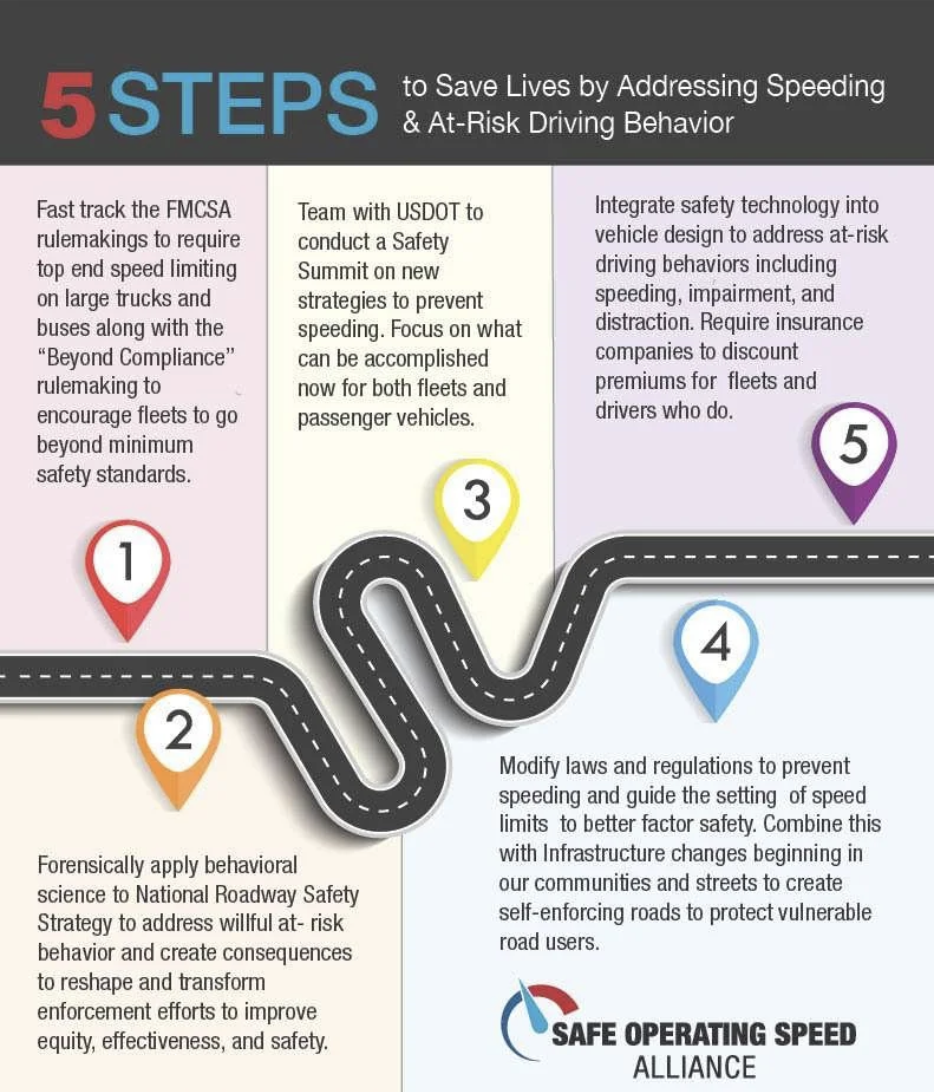
Together, we champion a comprehensive approach that integrates policy, technology, behavioral science, and infrastructure to create safer roads for everyone.
Founding Members



Partner Members


Speeding is Leading Cause of Crashes
The reality is clear: current approaches, including public awareness campaigns and outdated policies, are not enough. To reverse these trends, we need a bold, comprehensive strategy that addresses the root causes of dangerous driving and prioritizes proven solutions.
According to the National Highway Traffic Safety Administration (NHTSA), 39,254 people were killed in traffic crashes in 2024. Of those, 11,288 deaths were the result of speeding-related crashes—nearly 29 percent of all roadway fatalities. Large truck crash fatalities continue to exceed 5,000 per year and injuries exceeded 160,000 in 2024.
Technology Solutions
-
Intelligent Speed Assistance (ISA) is a vehicle safety technology that automatically limits vehicle speed to posted limits in real time. It works by using GPS data and digital speed limit maps to identify the current speed limit. When a driver exceeds that limit, the system provides feedback or takes action to help bring the vehicle back into compliance, while still allowing the driver to remain in control.
The purpose of ISA is to reduce ongoing speeding, which is a major factor in both the frequency and severity of crashes. Higher speeds not only increase the likelihood of a crash but also significantly worsen outcomes. ISA is especially relevant because it:
Promotes consistent compliance with speed limits across drivers and fleets
Reduces crash risk and associated costs
Works alongside technologies like telematics and dual-facing cameras to improve overall safety performance
In short, Intelligent Speed Assistance is a practical tool that helps align driver behavior with safe speeds, making roads safer without relying solely on enforcement.
-
Top-end speed limiter technology ensures that trucks do not exceed a pre-set speed, helping to reduce the risk of crashes, improve fuel efficiency, and lower the severity of crashes involving large trucks.
Since the 1990s, most Class 7 and 8 trucks (over 26,000 pounds) have been equipped with speed limiter technology. However, a national requirement to activate or standardize these limits has not been finalized. Proposed rulemaking proposed by the Federal Motor Carrier Safety Administration (FMCSA) and the National Highway Traffic Safety Administration (NHTSA) has been delayed for nearly twenty years.
A study by the United States Department of Transportation found that large trucks equipped with speed limiters were involved in roughly half as many high-speed collisions as those without them. Additional research from the Federal Motor Carrier Safety Administration and National Highway Traffic Safety Administration reinforces that speed limiters are a proven safety technology to mitigate or eliminate high speed crashes.
The evidence is clear: speed limiters deliver measurable reductions in crash frequency, severity, and associated economic costs. As a scalable and immediately deployable solution, they represent one of the most effective tools available to reduce large truck- related crashes and improve overall roadway safety.
What’s Happening Now
Fleet Management
Intelligent Speed Assistance (ISA) is already being used as an effective fleet management tool. One example is it’s use in municipal and government fleets, where ISA has been scaled as part of broader safety initiatives. The New York City Department of Citywide Administrative Services is in the process of deploying ISA across more than 7,000 vehicles. This program has already demonstrated significant reductions in speeding and shows how ISA can be embedded as a standard safety requirement across a large, complex fleet.
Super Speeder Efforts
Efforts to stop super speeders are shifting from enforcement alone to a multi-layered, prevention-focused approach in which technology limits dangerous behavior, enforcement deters it, and policy reinforces it.
There are legislative efforts to pass “Stop Super Speeders” laws that require repeat offenders to install ISA speed-limiting devices in their vehicles. These laws, already passed in Virginia, Washington State, and Washington, D.C., and proposed in states such as New York, are designed to target drivers with a demonstrated pattern of speeding.
Together, these efforts represent a fundamental shift in roadway safety—moving beyond reacting to dangerous driving after it occurs to proactively preventing it. By focusing on the highest-risk drivers and combining technology, enforcement, and policy, this approach aims to stop the most dangerous speeding before it leads to serious injuries or loss of life.